
When people search on Google, common questions appear in the “People Also Ask” section, such as:
- What is a bridge saw used for?
- How does a bridge saw work?
- What is the difference between a 3 axis and 5 axis bridge saw?
- Is a CNC bridge saw worth it for stone fabrication?
If you are involved in marble, granite, or quartz processing, understanding these answers can help you choose the right equipment—and stay competitive.
What Is a Bridge Saw Used For?
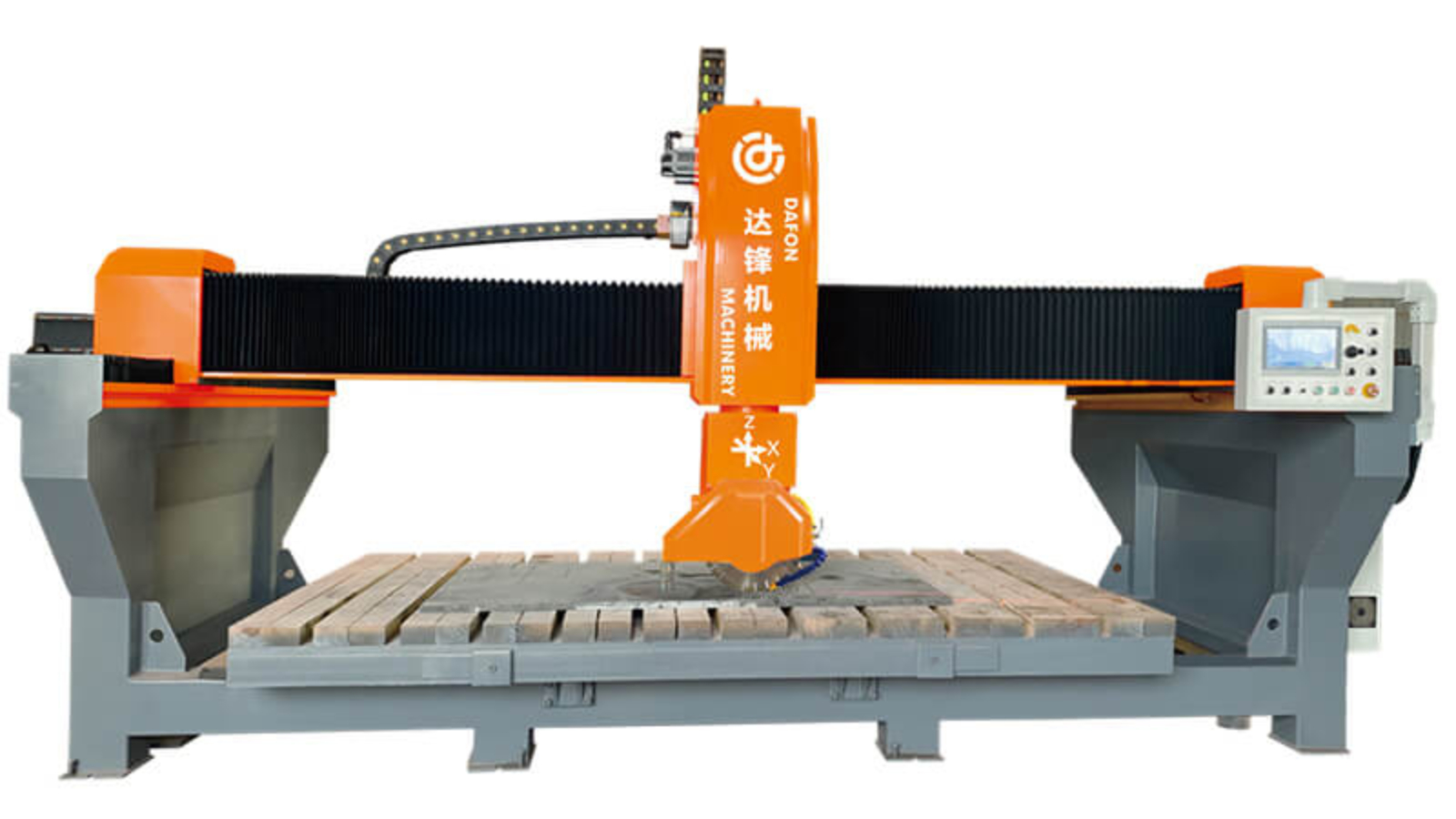
A bridge saw stone cutting machine is one of the most important machines in a stone fabrication workshop. It is mainly used for cutting marble, granite, quartz, and other natural or engineered stone slabs into precise dimensions.
Typical applications include:
- Kitchen countertop cutting
- Bathroom vanity fabrication
- Stair treads and risers
- Window sills and door thresholds
- Custom stone panels
For factories handling large volumes of slab processing, a bridge saw ensures consistent accuracy, smooth edges, and high productivity.
How Does a Bridge Saw Work?
A bridge saw consists of a horizontal beam (the “bridge”) that moves along rails over the stone slab. The cutting head, mounted on the bridge, travels across the slab to perform straight or angled cuts.
In traditional models, movement is manually controlled. However, modern CNC bridge saws use a computerized control system to automate the cutting process. Operators simply input dimensions or upload CAD drawings, and the machine executes the job with minimal human error.
Advanced features may include:
- Automatic blade tilting (0–45°)
- Rotating cutting head
- Laser positioning
- Vacuum slab fixing systems
These upgrades significantly improve efficiency and safety while reducing material waste.
3 Axis vs 5 Axis Bridge Saw: What’s the Difference?
This is one of the most searched questions online.
A 3 axis bridge saw typically handles straight and basic angled cuts. It is suitable for standard countertop fabrication and general stone processing.
A 5 axis bridge saw, on the other hand, offers greater flexibility. The cutting head can rotate and tilt automatically, enabling:
- Curved cuts
- Complex sink cutouts
- Beveling and chamfering
- Custom design processing
For factories targeting high-end projects or export markets, a 5 axis CNC bridge saw provides a clear competitive advantage.
Is a CNC Bridge Saw Worth the Investment?
Many stone factory owners hesitate because of the initial cost. However, when evaluating return on investment, several factors should be considered:
- Reduced labor costs
- Higher cutting accuracy
- Faster production speed
- Lower slab waste
- Consistent product quality
Over time, improved efficiency and reduced rework often offset the purchase cost. For growing stone businesses, upgrading to an automated bridge saw is not just a machine replacement—it is a strategic production upgrade.
Final Thoughts
In today’s competitive stone industry, precision, speed, and reliability are essential. A modern bridge saw stone cutting system transforms traditional slab processing into an intelligent, streamlined workflow.
Whether you operate a small fabrication shop or a large-scale stone factory, choosing the right bridge saw can directly impact your productivity, profitability, and market positioning.
If you are planning to upgrade your stone cutting equipment, understanding the technology behind bridge saw machines is the first step toward building a smarter and more efficient stone production line.
Add a Comment