
H2: The Short Answer
Use a bridge saw if you cut mostly slabs between 20–60 mm thick from blocks under 2 m long, especially when you need precise trim cuts, miters, or sink cutouts. Use a single wire saw if you cut large quarry blocks (2–4 m long, 1.5–3 m tall) into thick slabs of 50–200 mm for monuments, stair treads, or rough export. Each machine wins in its lane; the wrong choice costs you blade life, yield, and operator time.
H2: How Each Machine Cuts Stone
Understanding the cutting method makes the comparison much clearer.
H3: Bridge Saw Cutting Logic
A bridge saw uses a diamond-segmented circular blade mounted on a gantry that travels over a stationary slab or block. The blade rotates at 1,000–3,000 RPM and feeds into the stone at controlled speed. Bridge saws handle:
- Straight cuts across the block length
- Miter cuts on the head for edges and profiles
- Cutouts on finished slabs (sinks, cooktops, electrical holes)
Maximum cut depth depends on blade diameter. A 600 mm blade reaches about 215 mm in a single pass; deeper cuts require flipping the block.
H3: Single Wire Saw Cutting Logic
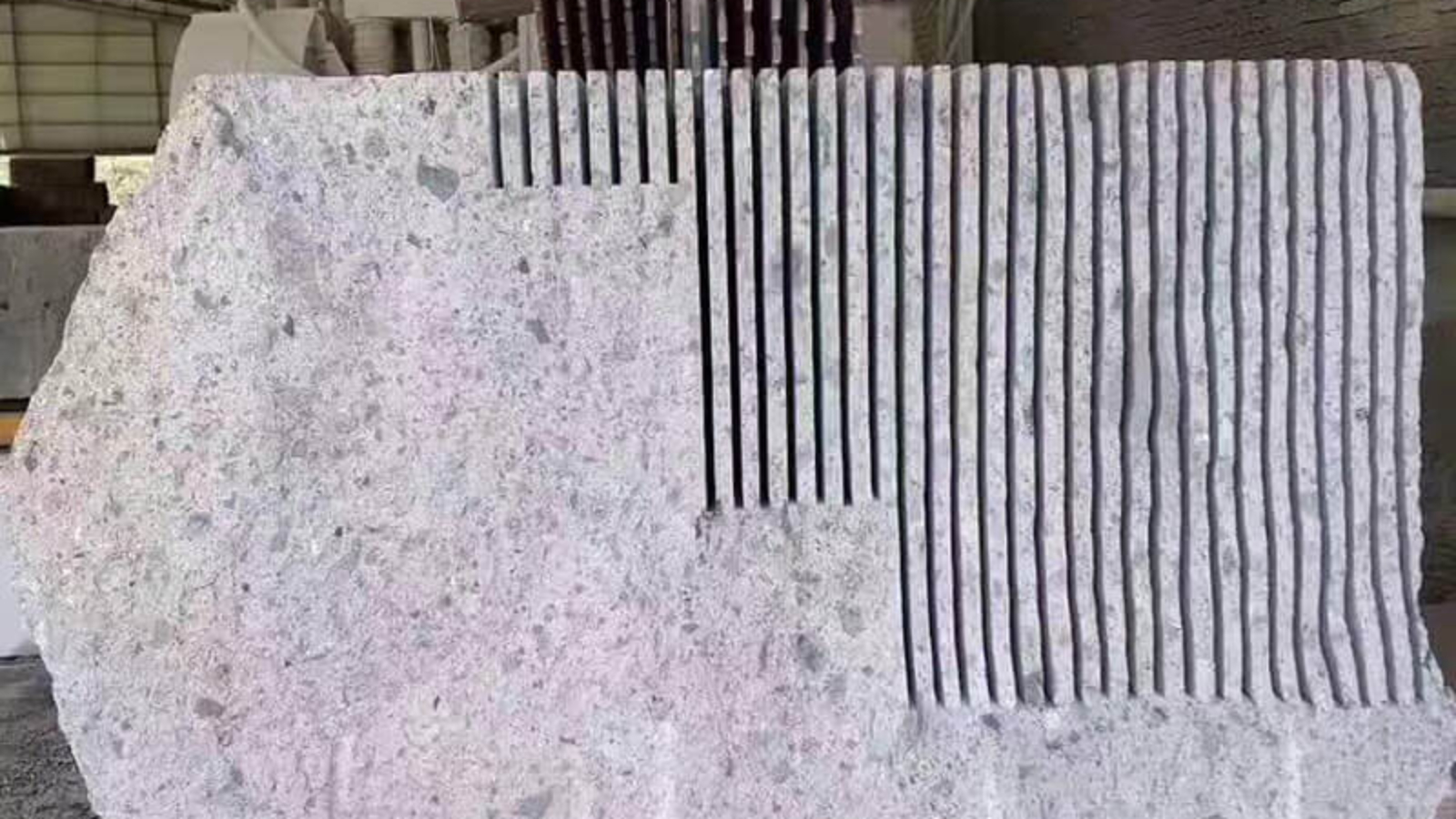
A single wire saw uses a continuous loop of diamond-impregnated wire traveling at high linear speed (20–40 m/s). The wire wraps around a large block and cuts vertically downward as the wire loop circulates. Wire saws handle:
- Very large blocks that won’t fit on a bridge saw table
- Thick slabs (up to 1.5 m in a single downward cut)
- Quarries where the block is still in place
- Curved or contour cuts that a straight blade can’t do
A modern wire saw can cut a 3 m × 2 m × 2 m block in 4–8 hours, producing slabs with one smooth (wire-cut) face.
H2: Head-to-Head Comparison Table
| Factor | Bridge Saw | Single Wire Saw |
|---|---|---|
| Best for slab thickness | 20–80 mm | 50–200 mm |
| Max block size | ~2.0 m × 1.5 m | 4 m × 3 m × 3 m |
| Output per hour | 8–15 m² (granite) | 4–10 m² (granite) |
| Blade/wire cost per m² | $0.40–0.80 (diamond blade) | $1.20–2.50 (diamond wire) |
| Surface finish | Often needs polishing | Wire-cut face is semi-finished |
| Operator skill needed | Moderate | Higher (wire splicing, tensioning) |
| Footprint | 5 m × 7 m typical | 9 m × 12 m typical |
| Power consumption | 18–30 kW | 45–75 kW |
H2: When a Bridge Saw Beats a Wire Saw
A bridge saw wins when your operation is finishing-oriented rather than quarry-oriented. In a typical countertop or tile factory:
- Changeover speed matters. Switching from one job to another on a bridge saw takes 2–5 minutes. A wire saw requires re-threading the wire loop (30–60 minutes) or significant repositioning.
- Per-cut precision matters. Miters, sink cutouts, and L-shapes only work on a bridge saw (or a 5-axis CNC version of one).
- Smaller blocks favor bridge saws. Anything shorter than 1.8 m cuts faster and cheaper on a bridge saw once you account for wire setup time.
If your block yard is producing 30–60 slabs per day for an indoor countertop shop, a 5-axis CNC bridge saw is almost certainly your best bet.
H2: When a Single Wire Saw Beats a Bridge Saw
A wire saw wins when your blocks are large, your slabs are thick, or your quarry volume is high:
- Quarry-direct cutting. Wire saws can cut blocks directly at the quarry face, eliminating the need to transport oversized blocks. A quarry producing 200+ m³ per month usually owns at least one wire saw for this reason.
- Thick slab specialists. Plants producing stair treads, curbstone blanks, or monument bases (100–200 mm thick) use wire saws as the primary breakdown machine and bridge saws only for the final sizing.
- Less waste on curved profiles. Wire saws can follow a curved template — useful for statues, columns, and landscape features — while bridge saws are essentially limited to straight and miter cuts.
H2: Many Plants Run Both
The most efficient mid-to-large stone operations typically run both machines in sequence: a single wire saw for primary breakdown of large blocks, then a bridge saw for trimming and value-added sizing. The two machines serve different steps in the workflow rather than competing against each other.
If you’re scaling up and choosing between them, start with the bridge saw and add a wire saw once your raw block supply justifies the capital outlay. For processors evaluating a fresh line, working with a manufacturer that supplies both — like Dafon Machinery’s bridge saw and wire saw lineup — keeps spare parts, training, and service contracts consistent across the shop floor.
H2: FAQ: Bridge Saw and Wire Saw Questions
Q: How long does a diamond wire last?
A: On granite, expect 60–120 running hours per wire (about 800–1,500 m² of cut area) before needing re-splicing. Marble can reach 200+ hours because it’s softer, while quartzite may drop to 40–60 hours.
Q: Can a wire saw replace a gang saw?
A: For lower-volume quarries and finishing plants, yes. For very high-volume block production (1,000+ m²/day), a multi-wire or gang saw still produces more than a single wire saw.
Q: What power supply do I need?
A: A bridge saw needs 3-phase, 380–415 V at 30–60 A depending on spindle size. A wire saw needs 3-phase power at 100–150 A due to the larger drive motors.
Q: Is wire saw water consumption higher than bridge saw water?
A: Significantly. A wire saw uses 30–50 liters per minute versus a bridge saw’s 8–15. Plan for an industrial water recycling system to keep operating costs manageable.
Q: How noisy is a wire saw compared to a bridge saw?
A: The wire saw is louder at 90–100 dB due to high-speed wire movement and pump noise. Bridge saws typically run at 78–85 dB. Both exceed safe exposure thresholds, so hearing protection is mandatory.
Add a Comment