
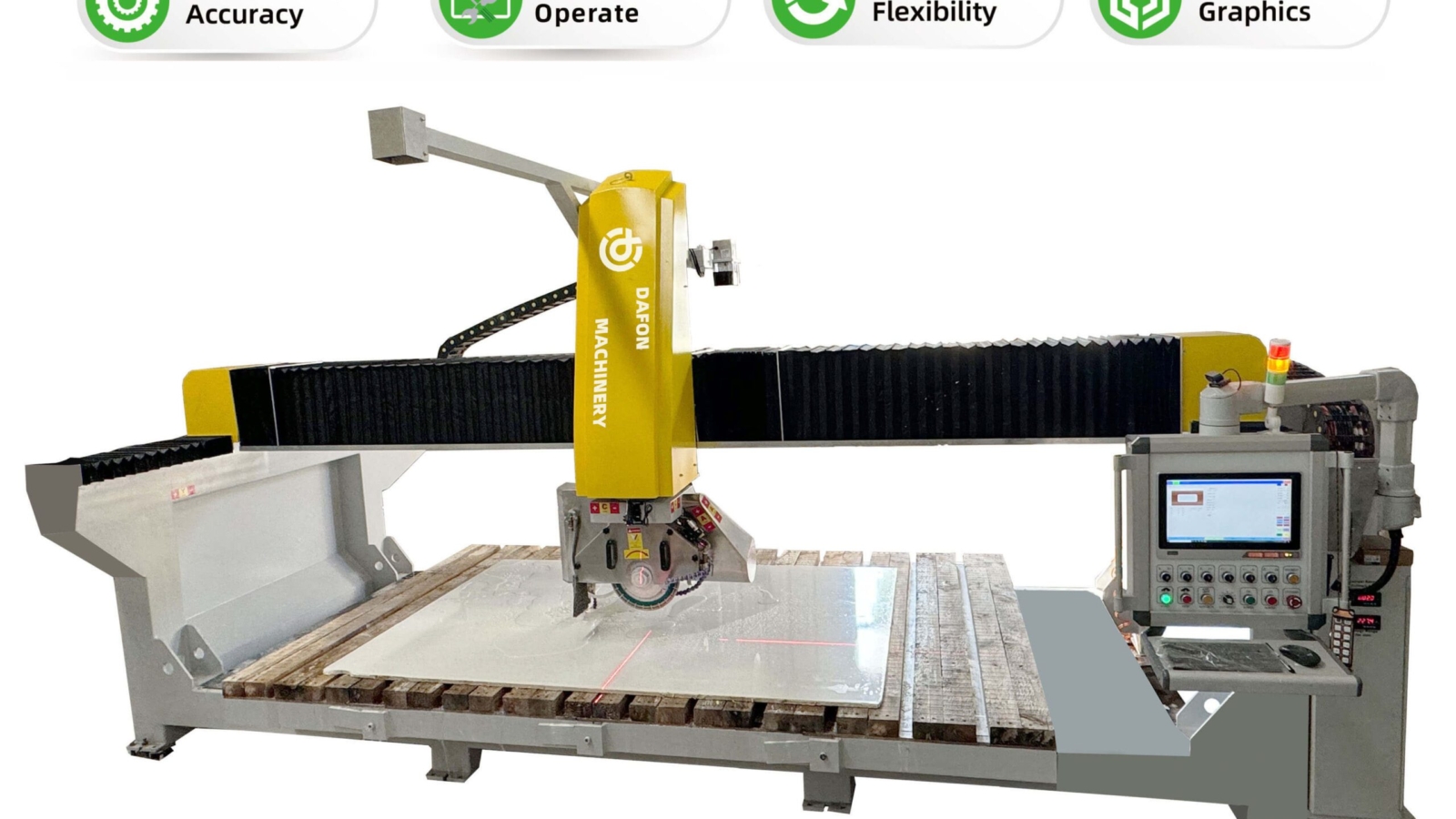
Choosing between a 5-axis CNC bridge saw and a 3-axis bridge saw is one of the most important equipment decisions a stone fabricator can make. The wrong choice either limits your product range or wastes capital on capabilities you never use. This comparison breaks down the real differences in functionality, cost, and return on investment so you can make an informed decision.
What the Axes Actually Mean
In CNC terminology, an “axis” is a direction of controlled motion.
- 3-axis bridge saw: Controls X (length), Y (width), and Z (vertical). The blade moves in straight lines and makes vertical cuts. It can produce rectangles, squares, and simple linear shapes.
- 5-axis bridge saw: Adds A-axis (blade tilt) and C-axis (blade rotation). The blade can cut at angles, make bevels, and execute complex 3D contours.
The extra two axes transform a simple cutter into a versatile machining center.
Cutting Capability Comparison
| Feature | 3-Axis Bridge Saw | 5-Axis Bridge Saw |
|---|---|---|
| Straight cuts | Yes | Yes |
| Rectangular nesting | Yes | Yes |
| Miter / bevel cuts | Limited or manual | Automatic, any angle |
| Sink cutouts with radius | Possible, slower | Fast and precise |
| 3D architectural profiles | Not possible | Yes |
| Undercutting | No | Yes |
| Column or baluster prep | No | Yes |
For shops producing standard countertops, vanities, and tile, a 3-axis bridge saw handles 80–90% of typical jobs. For architectural stonework, custom furniture, or high-end residential projects, the 5-axis CNC bridge saw opens entirely new revenue streams.
Programming and Operator Skill
3-axis machines are simpler to program. Most operators learn basic nesting and cutting paths within days. CAM software is straightforward, and troubleshooting is limited to X-Y-Z positioning issues.
5-axis machines require more advanced programming. Simultaneous 5-axis motion demands collision avoidance, tool-path simulation, and a solid understanding of workpiece fixturing. Training time is longer — typically weeks rather than days — and skilled operators command higher wages.
Speed and Throughput
On straight cuts, both machines perform similarly. Where the 5-axis machine wins is on complex geometry. A sink cutout that requires multiple setups on a 3-axis machine can be completed in a single setup on a 5-axis machine. For high-mix, low-volume architectural work, this efficiency adds up quickly.
For high-volume, low-complexity production — such as standard kitchen countertops — the 3-axis machine often delivers better parts-per-hour because there is no tilt-and-rotate overhead.
Price and Total Cost of Ownership
| Cost Factor | 3-Axis | 5-Axis |
|---|---|---|
| Machine price | 40,000–90,000 | 100,000–250,000+ |
| Tooling | Standard blades | Blades + angled adapters |
| Software | Basic CAM | Advanced CAM + simulation |
| Training | Short | Extended |
| Maintenance | Simpler | More complex (tilt/rotate mechanisms) |
The 5-axis CNC bridge saw is a strategic investment. It pays off when the additional capabilities generate new contracts that a 3-axis machine cannot fulfill.
Which One Should You Choose?
Choose a 3-axis bridge saw if:
- Your primary products are countertops, vanities, and tiles
- Volume is high and product mix is low
- Budget is limited and ROI must be fast
- Operator training resources are constrained
Choose a 5-axis bridge saw if:
- You bid on architectural, monument, or custom furniture projects
- Your clients request mitered edges, radius work, or 3D profiles
- You want to differentiate from competitors with standard equipment
- You have trained staff or budget for extended training
FAQ
Q: Can a 3-axis bridge saw be upgraded to 5-axis later? A: Generally no. The frame, drive system, and control architecture are fundamentally different. It is more cost-effective to sell the 3-axis machine and purchase a 5-axis model.
Q: Does a 5-axis machine require more floor space? A: Usually yes. The additional tilt and rotate mechanisms add height and depth. Verify ceiling clearance and slab loading access before purchasing.
Q: Is 5-axis cutting slower on simple jobs? A: No. A 5-axis machine performs straight cuts at the same speed as a 3-axis machine. The difference appears only when angle cuts are required.
Q: What control brands are common for 5-axis stone saws? A: Popular options include Siemens, Fanuc, and Osai. Ensure the control supports both G-code and conversational programming for flexibility.
Conclusion
The 5-axis vs 3-axis bridge saw decision comes down to product strategy, not just budget. A 3-axis machine is the workhorse of standard fabrication. A 5-axis machine is the gateway to architectural and custom markets. Evaluate your current order mix, your growth targets, and your team’s technical capacity before committing. Dafon Machinery supplies both 3-axis and 5-axis CNC bridge saws with full training and support.
Add a Comment