
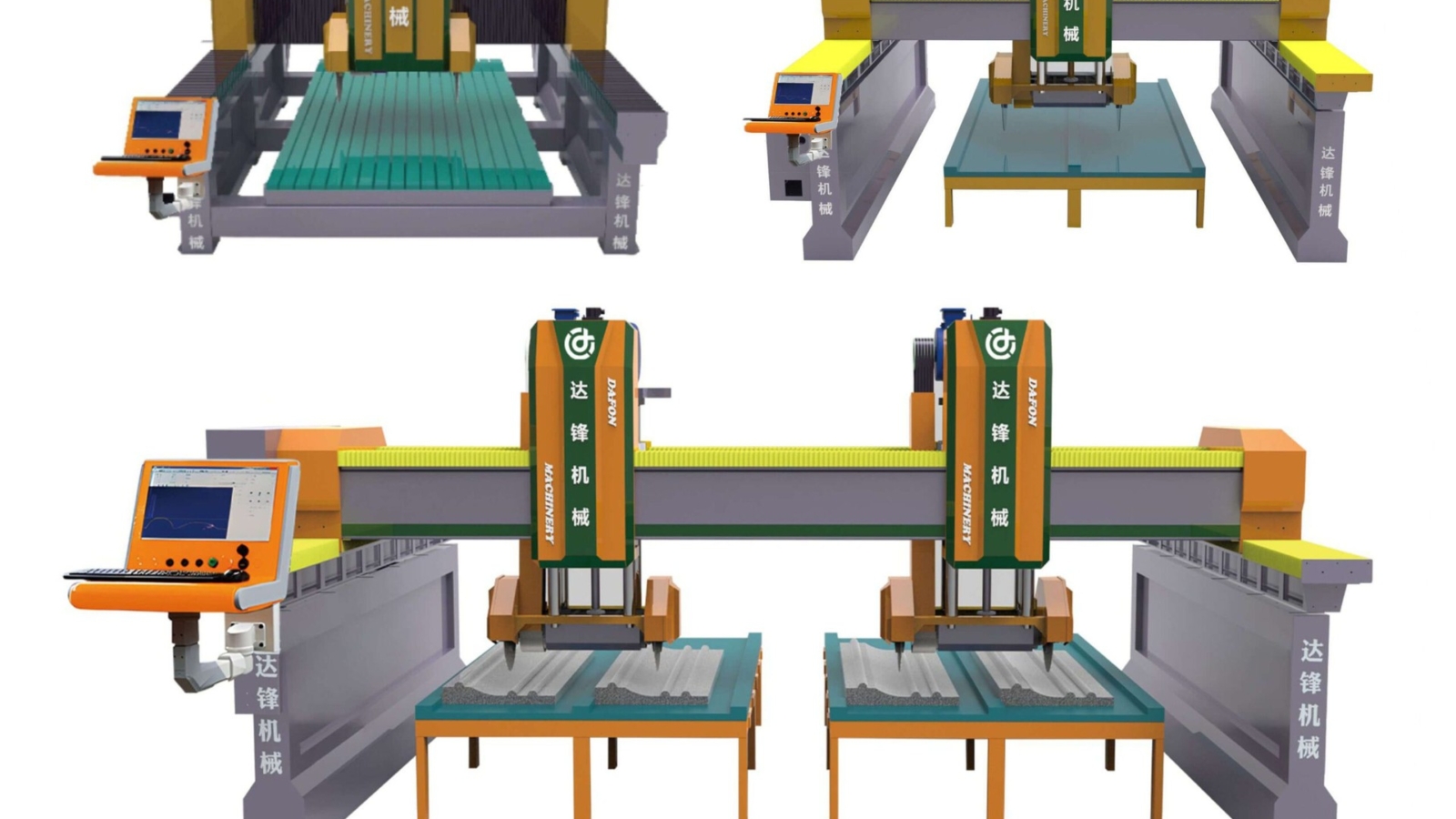
The Big Question: Bridge Saw or Wire Saw?
If you’re investing in stone cutting equipment, this is probably the decision keeping you up at night. Both technologies cut stone blocks into slabs — but they serve fundamentally different production models. Choose wrong, and you’re either bottlenecked on volume or overspending on capacity you’ll never use.
Here’s a straightforward comparison to help you decide.
CNC Bridge Saw: Precision and Versatility
A CNC bridge saw uses a single large-diameter diamond blade mounted on a bridge-style gantry. The blade moves along X, Y, and Z axes (with 4th and 5th axis options for profiling), making it incredibly versatile.
Best for:
- Custom slab cutting to specific dimensions
- Kitchen countertop and bathroom vanity fabrication
- Tombstone and monument shaping
- Profiling and beveled edge cutting
- Low-to-medium volume production (10–50 slabs/day)
Strengths:
- Cuts to exact dimensions — CNC control delivers ±0.5mm tolerance
- Handles complex shapes — curves, arcs, and profiles in a single setup
- Compact footprint — fits in smaller workshops (typically 6×4m)
- Lower upfront cost — entry-level models start around 15,000–40,000
Limitations:
- Single blade means one slab at a time — throughput is limited
- Blade wear affects cut quality more noticeably than multi-wire systems
- Not ideal for high-volume block-to-slab processing
Multi-Wire Saw: Speed and Volume
A multi-wire saw threads 30–80 parallel diamond-impregnated wires through a stone block simultaneously. It’s the industrial powerhouse for turning raw blocks into slabs at scale.
Best for:
- Block-to-slab processing in high-volume factories
- Granite and marble block cutting (100+ slabs/day)
- Thin slab production (tiles, veneer panels)
- Operations where slab uniformity across a block matters most
Strengths:
- Massive throughput — one block yields dozens of slabs in a single pass
- Superior slab flatness — parallel wires produce remarkably uniform surfaces
- Less material waste — Wire kerf is only 5–7mm vs. 8–12mm for blades
- Lower per-slab cost at high volumes — wire cost per square meter drops significantly
Limitations:
- Higher upfront investment — 80,000–200,000+ for industrial models
- Limited to straight cuts — no profiling, beveling, or custom shapes
- Requires large space — typical installation needs 15×8m minimum
- Higher technical complexity — wire tensioning and replacement need skilled operators
Head-to-Head Comparison
| Factor | CNC Bridge Saw | Multi-Wire Saw |
|---|---|---|
| Daily output | 10–50 slabs | 100–300+ slabs |
| Cut tolerance | ±0.5mm | ±1mm |
| Slab flatness | Good | Excellent |
| Versatility | Cutting, profiling, beveling | Straight cuts only |
| Footprint | ~24m² | ~120m² |
| Entry price | 15K–40K | 80K–200K+ |
| Best application | Custom fabrication | Volume slab production |
How to Choose: 3 Key Questions
1. What’s your daily slab target? Under 50 slabs → Bridge saw. Over 100 → Multi-wire. In between? Consider starting with a bridge saw and upgrading.
2. Do you need custom shapes? If your business involves countertops, tombstones, or architectural profiles, a bridge saw is non-negotiable. Multi-wire systems can’t profile.
3. What’s your material mix? Processing uniform granite blocks for tile? Multi-wire wins on cost per slab. Working with varied stone types and custom orders? Bridge saw’s flexibility pays off.
The Hybrid Approach
Many successful stone factories run both. A multi-wire saw handles bulk block-to-slab processing, while a CNC bridge saw takes those slabs and creates finished products. This combination maximizes both throughput and versatility — and it’s the setup we see in the most profitable operations worldwide.
Final Verdict
There’s no universal “better” option — only the right tool for your production model. Match the technology to your volume, product mix, and growth plans, and you’ll make an investment that pays for itself.
Add a Comment